
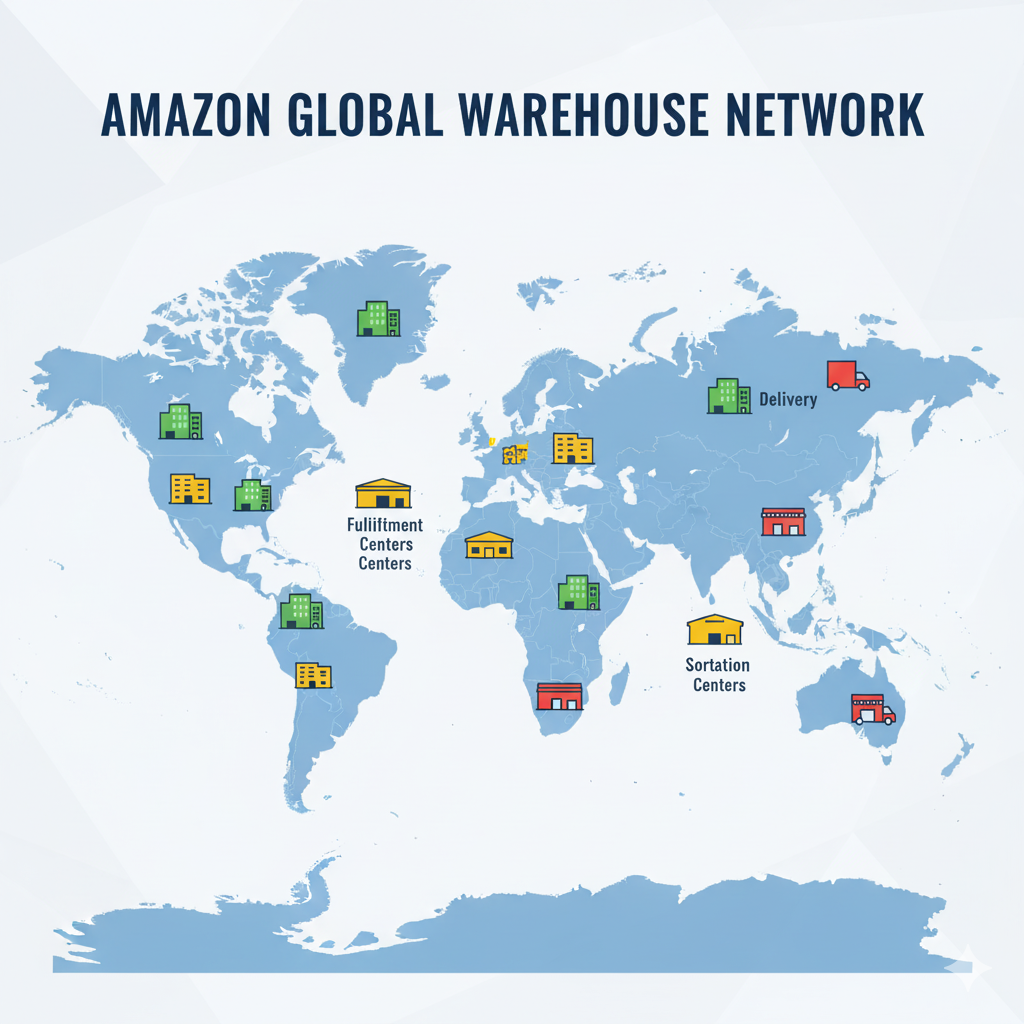
When people ask “how many warehouses does Amazon have?”, the answer isn’t always the same — because “warehouse” can mean different types of facilities. Does it mean huge fulfillment centers, or all delivery stations, sort centers and smaller hubs?
Let’s break it down.
What Types of Warehouses & Logistics Facilities Amazon Has
Amazon’s global logistics network includes:
- Large fulfillment centers (FCs) — where stock is stored, picked, packed and prepared for shipping.
- Sortation centers — where packages are sorted by destination (region, ZIP, etc.).
- Delivery stations / last‑mile hubs — smaller facilities from which couriers deliver packages to your doorstep.
- Cross‑dock hubs, inbound warehouses, and air‑cargo / transit facilities — depending on region and shipping routes.
Because Amazon operates all these facility types, total warehouse counts vary widely depending on what’s counted.
Rough Numbers: What Public Data Shows (As of Recent Estimates)
- Worldwide, Amazon runs about 1,200 logistics facilities — this includes fulfillment centers, sortation centers, delivery stations, cross‑docks and cargo hubs. Red Stag Fulfillment
- Among those, around 350+ are major “fulfillment centers” (FCs) scattered globally, which are the large warehouses most people imagine. Red Stag Fulfillment
- Spread across the U.S. alone, Amazon has hundreds of logistics‑type sites (fulfillment centers + smaller hubs), making it likely that many people in the U.S. live near at least one facility. Red Stag Fulfillment+2Fulfillment Hub USA+2
- Because Amazon frequently expands and builds new locations (especially delivery‑stations and sort‑centers for fast delivery), the exact number changes over time. Red Stag Fulfillment+1
Why the Numbers Vary — What “Warehouse” Means Matters
- If you count only large FCs, you get a lower number (≈ 350 globally).
- If you count every logistic facility — including sortation centers, small delivery hubs, air‑cargo hubs, cross‑docks, etc. — you get the higher ~1,200 figure.
- Some counts use only “active facilities,” others include “planned or under‑construction” ones, which further changes totals.
What This Means for Buyers & Sellers
- For buyers: A large and spread-out warehouse network helps Amazon deliver fast — often within 1–2 days for many regions.
- For sellers (FBA / third‑party): More warehouses — especially fulfillment centers — means Amazon can store and ship your products more efficiently, improving delivery times and customer satisfaction.
- For global reach: Because Amazon has logistics facilities all over the world (not just in one or two countries), it supports international shipping, cross‑region fulfillment, and global sales for sellers.
Final Thoughts
Amazon isn’t just a big online store — it’s a massive logistics network. Depending on what you count (main fulfillment centers vs. every warehouse and delivery hub), the number of Amazon warehouses ranges from a few hundred to over a thousand worldwide.
This massive infrastructure is one big reason why Amazon can deliver items so quickly and why it’s such a powerful platform for sellers across the globe.